
Muskogee City Directory Collections Access
Muskogee’s historical shelf is split between the library, the Oklahoma Historical Society, and a few digitized titles. The Muskogee Public Library genealogy department reports city directories from 1903 to the present in its local-history collection. The catalog statement identifies a run, not a promise that each volume is online or indexed. OHS supplies another route: its directory search accepts City and Year, then directs the result to the Research Center. Start with the year and city, record the volume or reel, and treat a finding as one dated observation.
| Collection | Years | Where Held | Access |
|---|---|---|---|
| Library city-directory collection | 1903-present, catalog claim | Muskogee Public Library Local History/Genealogy | Physical microfilm in person; remote article-copy request |
| Moore’s Directory | 1903 | Google Books item | Digitized title |
| R. L. Polk & Co. directory | 1906 | FamilySearch Library item | 382-page item on four microfilm reels |
| Telephone directories, OHS reels 139-141 | 1910; 1916-1959, with gaps | OHS Research Center | Microfilm catalog and in-person research |
The telephone run is not continuous. OHS reel 139 covers 1910, 1916-1922, and 1924-1934; reel 140 covers 1936-1948; reel 141 covers 1949-1950, 1952-1954, and 1957-1959. Its microfilm catalog also lists a 1902-03 and 1909-10 Oklahoma Gazetteer & Business Directory on reel 142. A gap should be noted as a gap, not filled by assuming a household remained in place.
The documented dates below separate Muskogee’s civic history from the specific directory items that have been identified.
| 1872 | Muskogee began as an MK&T railroad station beside the Texas Road. |
|---|---|
| 1898 | The city incorporated on March 19. |
| 1903 | Moore’s Directory appears as a digitized Muskogee title. |
| 1906 | The R. L. Polk & Co. item identifies a 382-page directory on four reels. |
| 2025 | A preservation grant supported Muskogee Phoenix microfilm digitization work. |
Grant Foreman Directories at Muskogee Library
The Grant Foreman Collection gives the local route its depth. The library describes more than 500 microfilm reels, including directories, county newspapers, census material, Dawes sources, court indexes, school census, obituary indexes, and allotment aids. Physical reels are viewed in person. For an article-copy request, email the person, address, approximate year, record type, and requested output to MuskogeeHistory@eols.org. The library lists a $10 research fee per request and phone 918-682-6657. That fee pays for research effort, not a guaranteed hit. Confirm walk-in or appointment hours before travel because the library notes schedule changes and a July 2026 catalog update.
See the library genealogy collection before asking for a scan. A precise request can name a directory year and a street. If the staff report no result, keep the wording narrow: not located in the searched volume or year. That is more useful than treating silence as proof that a person was absent from Muskogee.
The Grant Foreman Collection source page describes the library research channel and its physical microfilm access.
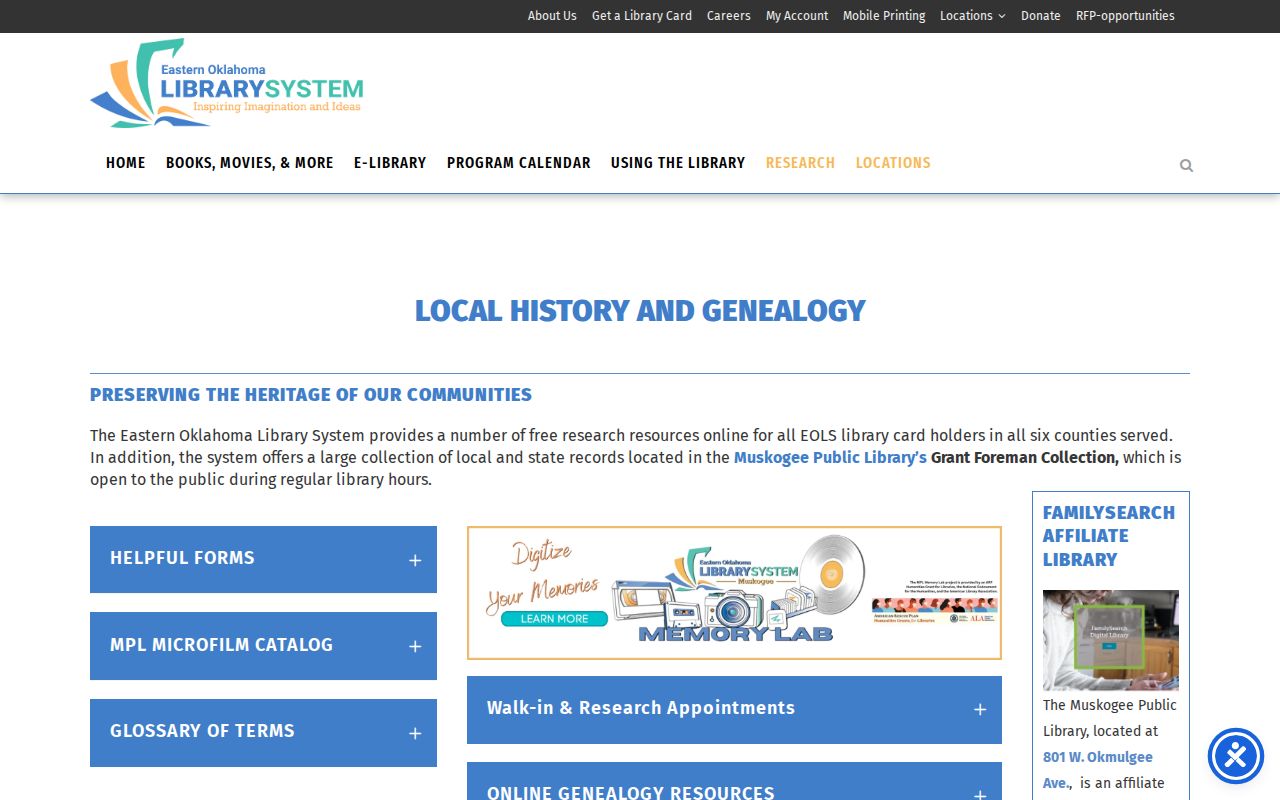
The collection view supports a reel-and-year citation rather than a claim that every local item has a searchable web image.
OHS Muskogee City Directory Reels
OHS complements the library with a city-and-year discovery route and broader territorial holdings. The OHS records page points researchers to census, directories, Dawes material, and territorial records at the Research Center. That matters in Muskogee because the city began as a railroad station in 1872, incorporated in 1898, and served as a Union Agency, federal-court, and Dawes Commission center. A directory address may therefore lead to records in a local collection, a territorial source, or a Five Tribes-related record series.
Use the directory result as a shelf lead, then write down city, year, reel or book, page, spelling, and the exact entry wording. OHS can also provide the context a city listing cannot: Dawes enrollment materials, census records, territorial court and naturalization holdings. Those sources may help distinguish two people with the same name, but no one source should be forced to answer every question.
The OHS City and Year search is the access point for a listed Muskogee directory at the Research Center.
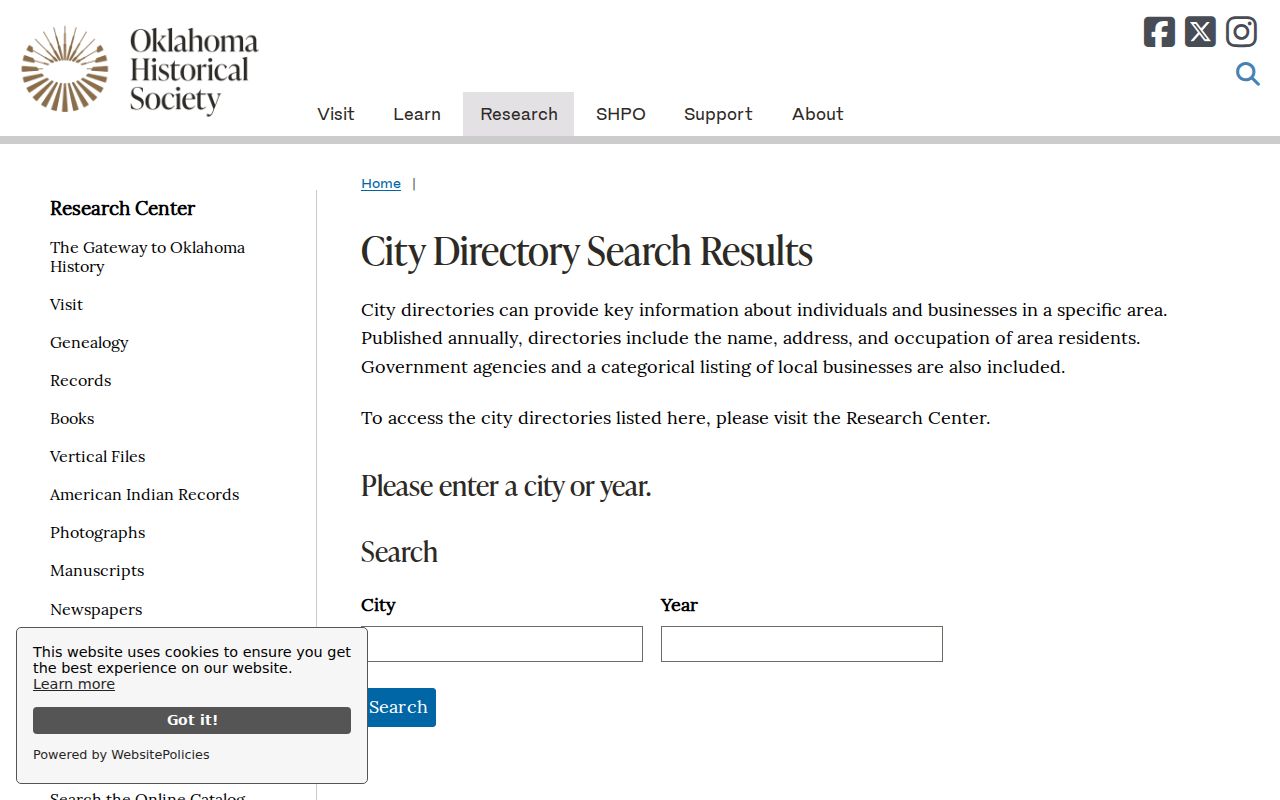
The form shows why a year should be part of every request, since the result is a research lead rather than a full online directory transcription.
Reading Muskogee City Directory Entries
A Muskogee city directory entry can carry more than a name and street number. Examples documented in the OHS African American historic-context report show a name, occupation or business role, address, rooming or boarding language, and sometimes a spouse or household relationship. The record can also preserve a historical racial notation. That wording belongs to the period source; it should never be turned into a modern identity claim. A business address is not necessarily a residence, and a lodging entry is not the same as a property record.
| Name | Spelling as printed, including initials or surname variants |
|---|---|
| Role | Occupation, business, proprietor or employee wording when present |
| Place | Street address, rooming or boarding location, or business address |
| Household clue | Spouse or other relationship language when printed |
| Dating clue | Directory year and the abbreviations used in that volume |
- Criss-cross directory
- A street-order section that can place a historical listing beside other entries on the same block.
- Householder index
- A name-oriented list that helps locate the entry before checking the address and household wording.
- Abbreviation key
- The volume’s shorthand guide. OCR has shown bds for boards, wf for wife, prop for proprietor, carp for carpenter, st for street, and av for avenue.
Those abbreviations are observed historical OCR terms, not present-day labels. Photograph or transcribe the nearby heading and page number. A directory’s internal key, when present, outranks a guess based on a modern use of the same letters. Follow an unclear location with a historical map or newspaper search.
Muskogee Records Before Statehood
The city’s record geography is unusual. After the MK&T railroad station was established, Muskogee grew in the former Muscogee Creek Nation and later reached into former Cherokee Nation territory. The Union Agency, the first federal district court in Indian Territory, and the Dawes Commission all worked here. The OHS city history explains that background, while the OHS records route identifies census, directories, Dawes, and territorial material. Together, they offer a way to test a directory clue that predates county online indexes.
For an early household, compare a printed listing with released census material, Dawes or Five Tribes material where relevant, and a date-specific newspaper reference. Do not convert an entry into a modern residence claim. The useful result is a documented sequence of names, dates, places, and sources.
The OHS archival records landing page gathers the historical categories that can help place a directory entry in its proper jurisdiction.
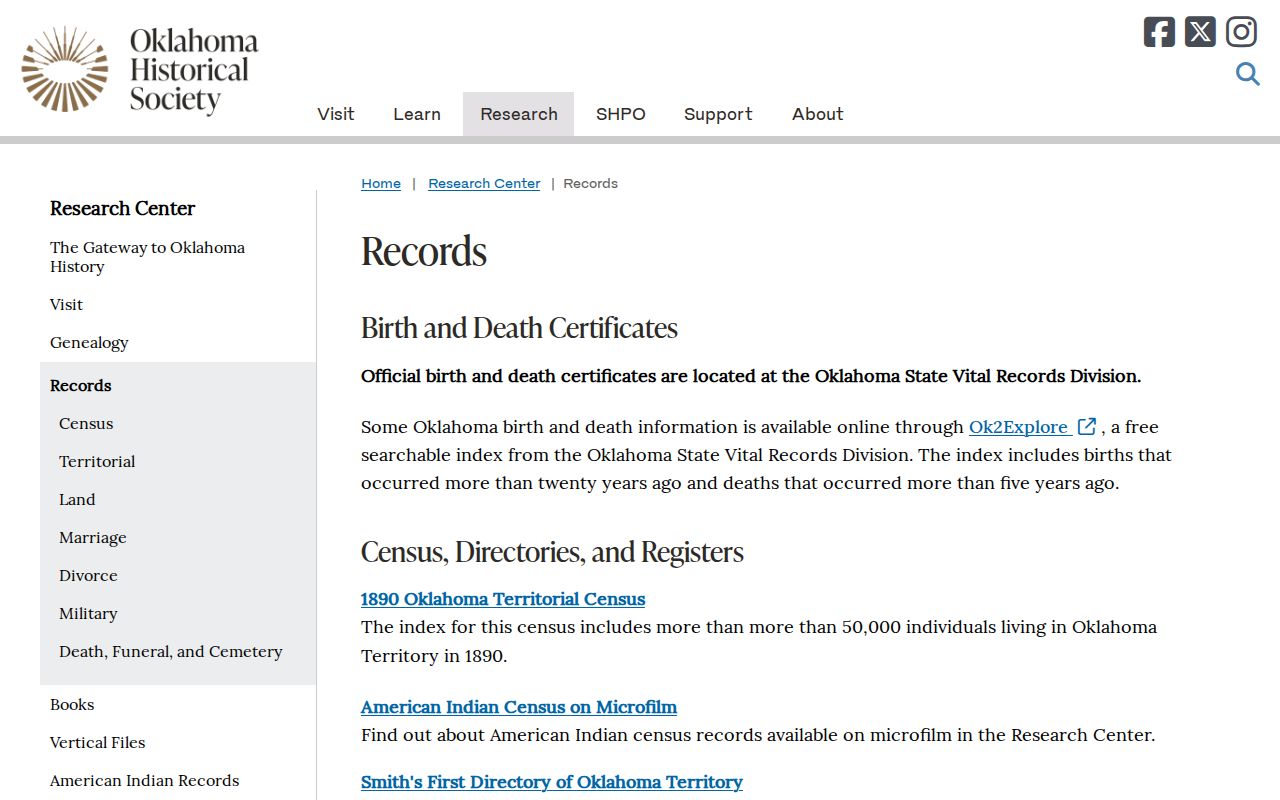
The archival landing page makes clear that directories are one collection within a broader set of census, territorial, and Dawes research paths.
Muskogee Phoenix Microfilm Preservation
A city listing becomes more useful when a newspaper confirms a date, address form, business, or family event. The library reports Muskogee County newspapers from 1875 to the present in its collection. In 2025, EOLS received a $25,000 Oklahoma Heritage Preservation Grant to preserve and digitize Muskogee Phoenix microfilm for Gateway, according to an OHS preservation release. The grant signals expanded preservation work, not a promise that any particular issue is already searchable online.
For a missing directory year, ask the library or OHS for the relevant newspaper access route. OHS states that its newspaper microfilm is free to use in person, non-circulating, and not available through interlibrary loan. Search the street in numeral and spelled-out forms, then save the issue date and page with the directory citation.
Note: A newspaper hit can support a dated address or event, but it does not by itself establish an uninterrupted household history.
Tracing Muskogee Directory Households
Use directories as a sequence, not as a roster of facts. Begin with the clearest surname and year, then work forward and back through nearby volumes. Record the printed form of the name, address, role, and any household clue before looking for a match elsewhere. Pair directory years with released federal or territorial census years, and use newspapers, probate, cemetery, or obituary indexes to resolve a disappearance. The Muskogee County Genealogical Society indexes can provide leads, but its transcriptions need confirmation against the underlying record where possible.
- Locate the first reliable Muskogee directory entry and preserve its year, page, spelling, and address.
- Check the next available volumes in both directions, noting a changed street, spouse reference, business role, or boarding wording.
- Use the criss-cross section when one exists, then compare the block with a map instead of assuming the same numbering still applies.
- Pair the dated listings with released census or territorial records and a newspaper or cemetery lead.
- Cite each reel, book, image, page, and access date, then mark years that were not held or not searched.
A name that vanishes might indicate a move, death, lodging change, an unlisted household, or a spelling difference. It does not establish any one of those outcomes. For a present-day address trail, the Muskogee by-street directory uses the county’s parcel and deed sources instead of rebuilding the historical shelf.
Muskogee Sanborn Directory Context
The 1898 Library of Congress Sanborn item is a seven-sheet snapshot of Muskogee’s buildings, streets, lots, materials, and uses. It can help read a city-directory address from that period, especially when an entry lists a hotel, business, or corner location. It is not title proof, occupancy proof, or a complete account of later changes. OHS map holdings offer a further archive route for plats, street maps, fire-insurance maps, and related geographic material.
Compare a Sanborn location with the directory’s year before drawing any conclusion. If the street is numbered, search both numeral and spelled-out forms. Preserve the historical address exactly as printed, then keep a separate normalized search version. This small distinction often prevents an OCR miss from becoming a false negative.